
by
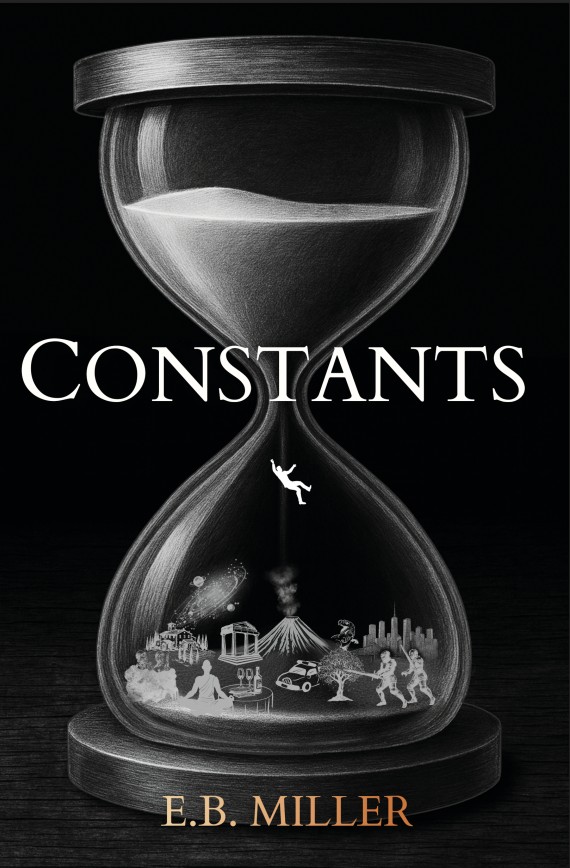


Every 18 minutes and 32 seconds, Marcus Robson wakes in a new reality. A cartoon home. A collapsing city. A living museum where art speaks from across the centuries. A shifting multiverse where nothing stays the same. The only clues that might lead him home to Lya, his pregnant wife, are the people, objects, and events that reappear across worlds—what he calls his CONSTANTS.
But every version of Lya he finds is a stranger. Earthquakes are getting more frequent. And whispers suggest someone else may be trapped in the same impossible cycle. As patterns emerge, Mark finds clues in a past he had hoped would stay buried. But will they lead him home—or reveal why he can never return?
Told in real time, with each chapter unfolding in a different world over exactly 18 minutes and 32 seconds, CONSTANTS is a literary science-fiction thriller that explores the boundless places imagination can take us when reality begins to lose its grip.
Editors:
Illustrators:
Cover Artists:
Genres:
-54p: Meadow
HE STANDS ALONE IN THE OPEN MEADOW. There are no beasts or dangling hazards to be seen. No loose mountainside or threatening waters. Zero terrain of note, but short grass in a soft breeze. His quivering grip holds a pocket watch as he stares at the relentless second hand, willing it to slow its pace while mourning the passing of each and every moment.
“Minute ten. Nine. Eight,” he mumbles.
His legs shudder beneath him, forcing his weight from side to side. His once-handsome features are crumbling away, replaced by a sallowing complexion of bad colours and a crown of disheveled, sparse dark hair.
“How?” he asks no one.
The same dilemma plays out repeatedly in his thoughts. He tries to analyze it, attack it from a thousand different angles, bend his mind to think it over and break it down into its smallest components until the theory of it all dissolves into a flatus of logic and his head just hurts.
READ MORE“Minute zero. Fifty-nine seconds. How do I come back?”
The one thing we were supposed to know about dying was its permanence. Without that—what the fuck?
Not that death ever made any sense to him, even back when the world still held its form. As a young man he had hoped to ignore the concept altogether by simply living to the fullest—more experiences, more memories, more travel, sex, and food. More going out, drinking, and hoping something, anything, would happen that would at least be worth remembering the next day.
“Forty-one seconds. Please make it stop. Forty. Please.”
As his relationship with Lya had progressed and vague talks of parenthood matured into real trying, he had begun to wonder if it was not creation that was death’s real opposite. That our clear path to steer away unease of the grave had always been to leave something of ourselves, better than ourselves. He even used this logic to try and calm himself after she told him the news.
“Thirty. Twenty-nine,” he says, barely audible. The horizon still lies bare in all directions. There’s no dangerous company or even so much as a dubious-looking cloud.
Now? In the reality roulette that is flux, he’s come to realize that time itself is the one true antithesis of death, as only on the brink does one learn to grasp not just the significance, but the very meaning of a year, a month—or, in his case, a minute, a second.
“Twenty-two. Twenty-one.”
There is, however, a specific denotation of time that he counts towards that looms larger than the rest. The obsessive countdown, the endless ticking to that single marker, has begun to circle his every thought. Sweaty palms tighten on the watch as he feels the seconds closing in. “Fifteen. Fourteen.”
There’s still nothing new in sight. He tries to take solace by finding some moment they’d had together—their wedding, a kiss, a meal, anything—but the only thing that seems tangible is a profound sense of urgency. He can’t handle the intensity of the present. It feels like his heart might explode. Is that how it’ll happen? Heart explosion!?
“Ten. Nine.”
And is that still only his leg shaking?
“Eight.”
The horizon ripples nauseatingly back and forth like it’s made of liquid.
“Seven. Six,” he says louder. Fifty feet in front of him there’s a split in the grass. A widening crevice that slithers towards him like a famished serpent. “Five! F—” The shaking throws him to his knees. “Three!”
The serpent expands its maw. “Two!”
He lifts the pocket watch to his face. “One . . .”
As his vision of the second hand blurs, as the moment itself seems to explode with anticipation, the earth opens up and swallows Marcus Robson whole.
His last coherent thought arrives with a hollow kind of calm as at least his obsession has been proven correct—death at exactly 18 minutes and 32 seconds is constant.
I
16 hours, 22 minutes, 16 seconds later
P0: Appointment #1
The scratching of pen on paper signals the beginning of a newfound consciousness. He inhales slowly to calm himself, but is already aware of the countdown starting again deep in the recesses of his mind.
18 minutes, 30 seconds.
Mark doesn’t want to open his eyes. Right now, it is like the entire universe conspires to pin him in place, so that the concept of doing anything—even just meeting this new world—seems like a Herculean task far beyond him.
There are the sounds of muted traffic and writing. His head is comfortably elevated, and he feels like he’s lying face up on a hard cotton couch. His sleeves are rolled up, and the stillness on the hairs of his arms tells him he’s indoors. The couch is too hard and the muted traffic too noisy for this to be home, but if he’s lucky she’ll be here. His eyes stay closed as he realizes that it’s this hope that is keeping him still.
18 minutes, 18 seconds.
A single cherry blossom petal floats across his thoughts. He follows it as it drifts past, though he already knows where it’s going. He can see her lying down under the shade of the cherry tree. She has the big sunglasses, the white sundress, and is lost in the faded paperback propped up on her swollen stomach. He calls out to her, but she doesn’t seem to hear him. He stumbles towards her, reaches out a hand to touch her, to lightly graze her cheek—
A male cough interrupts the sound of writing. Eyes snap open to a white popcorn ceiling. He looks down and confirms he’s lying face up on a pine-green couch. The wedding ring on his finger is a wide band of gold. Beyond his faded leather shoes is a wooden door surrounded by four framed diplomas. To his right there’s a coffee table, a thick armchair, and an aging world map pinned to the chestnut wall. He sees no clock.
A calm voice from behind him: “Are you ready to get started?”
Mark pushes himself into a seated position, and looks at the bearded man watching him from behind a desk by the window. Neatly spread out in front of the man are an amber-shaded banker’s lamp, file folders, and a beefy notebook over which a pen hovers. The two men lock eyes.
“First thing’s first, Mark. As long as there are no immediate health risks, everything we discuss here is completely confidential.”
At the realization he’s in a therapist’s office, Mark lets out a light laugh that rides his exhale.
The Psychiatrist’s chin lowers an inch, but his gaze remains fixed. “Different from how you imagined it?”
Mark doesn’t respond as he gets to his feet to explore the small space. There’s a bulletin board and a floor-to-ceiling bookcase that he supposes could be the culprit—if it fell in a certain way. On the shelf there are a variety of psychology-sounding titles he’s unfamiliar with: The Power of Words, Harmony Counselling, and Dreams and Wellness. Then he spots a few historical titles he does recognize: The Rise and Fall of Communism, Space Race Resilience, and The Dawn Army.
“Nothing from before the twenty-first century?” Mark asks in the jagged manner of one who hasn’t used their voice in a while.
“Keep looking. History is an interest of yours?”
“Archaeologist,” Mark grunts, somehow as one single sound, as he scans more titles.
“Ah, a man of science.”
Mark considers this a dumb comment and doesn’t know how to reply. The Psychiatrist seems to realize this and quickly follows up, “What drew you to archaeology?”
“Working a desk never exactly struck me as exciting. Oh, here we go—Our History, Iron Age Mentality, Gilgamesh . . .”
There’s a certain comfort in seeing these books he knows. Like he could hide in their pages in a world that at least feels familiar. He skims through Norse Legends and comes across a sketch of villagers being attacked by snakes.
A jolt of fear runs down his spine as the countdown catapults itself into his attention.
16 minutes, 34 seconds.
He looks out the window to change his thought process. Across the street, a winged gargoyle sits on the corner of a drab Gothic building. Its long teeth catch Mark’s eye, and he wonders how they might feel sinking into his neck.
“Is this your first therapy session?”
He imagines the gargoyle beginning to shake, stone eyes quivering, weathered concrete loosening and crashing towards the street below. A low tremble passes through his chest. The book falls from his hands, hitting the carpet with a thump, and he hurriedly returns to the sofa, where he shuts his eyes and hopes to conjure images of the cherry blossom.
“Mark?”
16 minutes and 15 seconds, he estimates, but the shrink might have thrown him off.
The sound of writing stops. Mark hears a shuffle by the desk and then a plop to his immediate right. He peeks open an eye to see the Psychiatrist looking down at him from the armchair, his pen poised but motionless. Mark notices a gold watch on his wrist.
“It’s worth mentioning that while there is a medical reason for you being here, we’re also just two people meeting for the first time, so it’s perfectly normal to take some time to build trust and comfort.”
Mark scans the man’s face: trim beard, thin spectacles, and light brown eyes that are a bit too piercing, with both a subtle kindness and a deep intensity. He feels like he recognizes a bit of himself, but just barely. The Psychiatrist is a few years older, likely early forties, with a nose that looks like it was broken at least twice, and hair that is both tamer and lighter than his patient’s.
“Does what I described sound okay to you?” the Psychiatrist asks.
“Time?”
“Excuse me?”
Mark slowly pronounces his clarification. “What time is it?”
The Psychiatrist furrows his brows, but looks at his watch as he slowly draws out his own response. “Two twenty-four p.m.”
“Can you set a timer for . . .” Mark waits a moment. “. . . fifteen minutes?”
The Psychiatrist stares for an awkward moment, then smiles politely as he sets his watch. “What am I timing?” he asks.
Mark doesn’t answer as he stares at the watch. It’s modern, digital. He’s seen nothing that wouldn’t belong back home. Could this be . . . ?
The Psychiatrist clears his throat to ask another question, but Mark beats him to the punch. “Do you mind if I use your phone for a second? I need to look something up.”
“You don’t have a phone . . . ?”
Mark checks his pockets, and confirms he has none. “No. It’ll be two seconds.”
The Psychiatrist narrows his eyes but hands over his phone. Mark quickly types his home address into a map search and counts the seconds as the page loads—as usual, there are no matches. The streets around where his home should be have different names and run in different directions, as if at some point the entire area was demolished and remade. Disappointment hits him in waves, draining his energy.
“What did you look up, Mark?”
“Home.” He pushes the phone away, rolls farther into the couch, and breathes into the fabric.
“Mind facing me while we talk?” the Psychiatrist asks.
Mark ignores the question and focuses on the minute details of the material in front of him. He imagines crawling amongst the green cotton divots and strains on a string of fabric and running from giant inse—
The Psychiatrist makes a light smacking noise Mark doesn’t appreciate. He wants to ignore the shrink, but the scribbling of his pen grates on his consciousness like a child tugging at his sleeve.
“I don’t want to be here,” Mark announces into the sofa. “So can we just not say or do anything for a bit?”
“Then you can go,” the Psychiatrist says with force.
That didn’t sound like a shrink. Mark rolls over to look at the Psychiatrist—his checkered shirt, khaki pants, and old loafers—then he looks past his own shoes to the heavy wooden door at the end of the room. He tries not to imagine what might be prowling beyond it.
The Psychiatrist keeps speaking, but more slowly. “Now is a pretty good opportunity to talk to someone who may be able to assist you. Why don’t you tell me what’s on your mind?”
“Know why they call ’em shrinks?” Mark asks.
“I don’t think all that many people do anymore.”
“From the Jivaro tribes in the Amazon who shrank the heads of their enemies.”
“I’m sensing you’re not sold on the merits of therapy.”
“Don’t take it personally. My issues are tied to bigger shit than whatever words you choose.” He looks over to the desk. “Got anything I can snack on?”
The Psychiatrist dismisses the question with a wave of his hand. “I’m afraid not. Mind telling me what bigger shit we’re referring to?”
“Not even like a granola bar?”
“I have no food in this office. What bigger shit?”
He doesn’t want to see it—that same expression they all make. The slow downwards morphing of the face. The calculation followed by doubt and judgement. Why would anyone believe him? Is there some way he’s supposed to act to sell it better? Should he be sweating? Screaming? Pulling his hair out while wearing a flashing sign that says reality jumper?
His natural reaction is to keep his mouth shut. To shut down—but Lya would want him to talk.
Of course she would. Give him a shot at least, she’d say.
Do it for her.
So you can tell her you tried.
A breeze in his mind scatters pale petals as Mark pans the room with a long exhale. “Okay, Doc,” he says. “Let’s say one morning you wake up, step outside your front door, and see something that you had—until that day—always thought was impossible.” He wags his head as he contemplates a scenario. “Let’s say you see a pegasus. What would you think is happening?”
“What would I think is happening if I saw a pegasus outside my front door?”
“Just soaring across the sky,” Mark responds, with a vague hand gesture across the room.
“Can you tell me why you’re aski—”
“Nah. Just answer it. Quick, please.”
“Okay, well, perhaps”—he clears his throat—“I’m suffering from a cognitive disorder that causes hallucinations.”
“I thought you’d get that one first. But what else could be happening?”
“I could be having a seizure, or—”
“Also a cognitive issue,” Mark interrupts. “What other explanations could there be?”
“Perhaps someone slipped something into my morning coffee. A hallucinogen.”
“You’ve been drugged. That’s two. Easy-peasy. All right, and for what other reasons might you be seeing a pegasus?”
“I never woke up, and I’m actually still dreaming?”
“Dreams, comas, long naps under the oak tree. What else you got?”
The Psychiatrist bites the cap of his pen. “Nothing else comes to mind.”
“Just those three? Delusional, drugs, or dreaming? No other theories for why a pegasus is flying above your neighbourhood?”
The Psychiatrist seems thrown off by the intensity of the questioning. “Well, what other explanations do you have?” he asks.
“I have one more, but I want to see what you come up with first.”
The Psychiatrist’s eyes narrow. He scribbles something into his notebook, but keeps his gaze on Mark as if he might sneak away if he looks down. “Why don’t you tell me about your pegasus, Mark?”
The words taste like copper before they even reach his lips. “Well . . . I’m going to die. Soon. Very soon.”
The Psychiatrist nods slowly like he was expecting something like this. “You have a terminal diagnosis?”
“Something like that,” Mark responds quietly.
“I’m sorry. That must be challenging to come to grips with.”
“That wins the putting-it-mildly award.”
“How long do you have left?”
“What’s your watch say?”
The Psychiatrist glances down. “There’s eight minutes, sixteen seconds left on the timer.”
“That’s it.”
“That’s what?”
“That’s how long I have left.”
The sound of traffic from outside pauses as if waiting on the Psychiatrist to react, but he remains motionless like he’s expecting clarification. When no further explanation comes, he reverts to writing something down. “You think you’re going to die in just over eight minutes?”
“With a hundred percent conviction, yes.”
“And why do you believe that?”
“Because I die every eighteen minutes, thirty-two seconds. Then I wake up somewhere new, then I die again. I know—I don’t really seem like the delusional type.”
A beat of silence, then the Psychiatrist’s hand bursts into a frenzy of motion. The shrink did good, Mark thinks. Hardly reacted despite the conclusions Mark knows must be taking place in his mind.
“How do you . . . think it will happen?” the Psychiatrist asks.
“Well, let’s see. A day ago I was strangled by a sequined assassin, a few hours ago I was decapitated by a swivel cannon, and most recently I was eaten by a giant talking house cat that loved riddles.”
The Psychiatrist leans forward, nudging his glasses. “Mark, are you—”
“It doesn’t matter how many times you do it—dying never gets any easier. I’ve been buried, pulverized, and suffocated by earthquakes—so many goddamn earthquakes,” he says with a quasi-laugh. “They say your life flashes before your eyes, but how the fuck would they know? Truth is, there are no strolls down memory lane. No grand realizations or sudden flashbacks. Lately I’ve been pissing myself. You know, you’d think repeatedly meeting your demise might smooth the edges off the whole goddamn ordeal—but oh, it’s the opposite. Every time you come back you’re a little more disturbed”—Mark taps his temple with two fingers—“in your growing expertise of all those little details that make each way of dying its own special hell. You become too aware of how we’re just meat stuck together”—his voice approaches a whisper—“and it’s not beneficial to know, to really know, that that which we are made of is fundamentally no more special than a pork chop.
“So what might get me here?” He sticks out his bottom lip and gestures around the office. “Maybe a comet bursting through the drywall and getting me right in the solar plexus. Maybe an axe man kicking the door in and chopping me down to size. Or could just be another good ol’-fashioned earthquake. I do have a thing for earthquakes—or maybe they got a thing for me. Hard to tell. Truth is, Doc, I don’t know how—all I know is when, because I die on time. So if there’s anything you can say that you think is gonna somehow assist with that . . . then you’ll have to be quick.” Mark stops and catches his breath.
He didn’t think it was possible, but the Psychiatrist’s stare seems to have somehow increased into a new level of fortitude. “Tell me about your family.”
“What about them?”
“Is there any history of mental illness?”
“My sister—my twin sister—had psychosis, probably.”
“She was never formally diagnosed?”
The words leave Mark’s lips, though he’s not entirely sure he gave them permission. “No. By the point it started coming out, she was already a full-blown addict bouncing back and forth between the streets, shelters, and squats. Just finding her took usually a day of driving around, and it was the same story every time—you try to convince her to get help, but she acts like you’re pulling her goddamn teeth.”
“Where is she now?”
“No idea. Haven’t heard from her in six years. Cops told me the last time they picked her up she was wandering around suburbia screaming about the shadow people watching her. This really what you want to be spending our time on?”
“That must have been challenging for your family.”
“My dad left when we were kids and my aunt didn’t give a shit about Alex.”
“And your mother?”
“She died when we were eleven. We at the five-minute mark?”
The writing stops. “I’m sorry, Mark.”
“Time, Doc?”
The Psychiatrist glances down. “Five minutes, twelve seconds.”
Mark hates how people react when they find out he lost his mother in childhood, like he’s instantly a pity case—it’s partly why he rarely brings it up. Thankfully, though, the Psychiatrist doesn’t hold the sympathetic expression long. He bites his lip, looks at his notebook, then looks back up.
“When you searched my phone, you said you typed in ‘home.’ Why?”
“What else even matters?”
He gestures towards Mark’s ring. “What’s your partner’s name?”
“Lya.”
“And have you told her what you think is happening?”
“She doesn’t . . . believe me.”
The Psychiatrist nods knowingly, but Mark reminds himself the guy doesn’t know shit.
“Do you ever feel like strangers are talking about you?” the Psychiatrist asks.
Here we go.
“No.”
The moustache hairs above the Psychiatrist’s lip quiver. “Do you feel like people are plotting against you?”
“The whole goddamn universe is plotting against me . . .”
“Do you ever hear voices without a body?”
“Sometimes. Not often.”
Furious writing, then a question. “And how long has it been since you feel you’ve been dying repeatedly?”
Mark rolls his tongue around his mouth before he answers. “I think about four days . . . but it’s hard to keep track.”
The pen pauses. “Only that long?”
“That’s a whole lot of eighteen-minute-and-thirty-two-second intervals,” Mark says, louder.
“And before that, had you ever had this . . . sensation before?”
“This sensation of dying? No.”
“Are you sleeping?”
“Since this started? No.”
“A lack of sleep could very likely be a contributing factor.”
“Oh, I don’t know, there’s just something about imminent annihilation that makes it hard to doze off. Three thirty?”
The Psychiatrist looks down. “Three twenty-five.”
“Well, I’m gonna go—trust me, it’s in your best interest for me to be away from you—so, if you have anything to say, have at it.”
The Psychiatrist scribbles away, then puts his notebook down and talks at a rapid clip. “Well, I hope you stay longer. There’s nothing simple about diagnosing anyone, and whatever you’re dealing with, this reality-fracture aberration, it clearly has some nuance to it.”
“Reality-fracture aberration,” Mark repeats flatly.
“Mark, I can’t say this clearly enough—this belief that you are dying repeatedly is a delusion. Now, I understand it feels absolutely real to you, but the longer you accept a delusion, the harder it becomes to uproot, so we need to act on this now. There are many different factors that can cause a delusional disorder. The family background you described means you could be susceptible to some form of psychosis or schizophrenia, but at first blush you don’t seem to have many of the common symptoms like disorganized speech or irrational behaviour—and the shortened duration means we need to investigate whether something else is at play. I’d recommend a CAT scan and medication, specifically Thorazine, which reduces the frequency and intensit—”
“Do you have any pills here?”
“I can write you a prescription, or if you come back—”
“I’m not coming back. I don’t go back to places. That’s not how it works.”
“Mark, I also get the sense that you’re feeling apathetic—”
“How insightful.”
“I want you to know that I’m here to support you, and we can work on this together if you care to come back.”
“I’M NOT COMING BACK!” He takes deep breaths as he feels the end approaching. It’s right through those walls, waiting for him. “I’m not coming back. And it’s not about what I want. That’s like half the goddamn problem.”
“Mark, who do you think made this appointment if you just appeared here?”
“Great question. No clue,” Mark says as he pushes himself up off the couch. “Well, this was helpful. Definitely delusional with a wee bit of apathy. Top notch session, Doc.”
“I need more time,” the Psychiatrist says with a newfound tinge of desperation.
“Preaching to the choir,” Mark replies as he heads towards the heavy wooden door.
He pulls it open and comes face-to-face with a pitch-black nothing across the threshold of the doorway.
His thoughts spiral away as he stares into the starless night in front of him—the very crystallization of darkness.
Mark leans a shoulder into it but can’t advance through what feels like a solid barrier, both smoother and colder than the painted wall. He turns back to the Psychiatrist, whose eyes and mouth are both agape as he rushes to the doorway.
“Who blocked off my waiting room? I walked through it not an hour ago!” The Psychiatrist places a shaking hand on the absolute ebony. “Hello?! Can anyone hear me?” he yells into the void.
No response from beyond the doorway. Mark takes a step back and stares at the blackness. It looks as if the universe’s fabric is nothing more than carbon paper, and that whatever piece lay next to the Psychiatrist’s office had been cut away. He walks over to the window and looks down at the only other way out: a straight, vertical descent to a concrete pavilion four storeys below. “Doc, looks like you’re stuck with me. You might wanna hide unde—”
The Psychiatrist is rushing around the office, placing his hands on the walls like he’s looking for a secret passage, then turning back to the void as if hoping it will have politely taken its leave. Mark feels a pang of guilt for dynamiting the man’s sense of reality, then reminds himself that the sole benefit of no control is no responsibility.
He feels a burgeoning sense of intense urgency. A horrible, primitive sensation which he’s recently started referring to in his thoughts as the stretch. Like his body and mind have stumbled into some inherent response that comes from being molded into the cadence of an impossible curse. His heart rate crescendos. Fear thickens and spreads in his chest. There are only moments left until his death, but he’s yet to identify its cause. “Twenty seconds?”
The Psychiatrist seems to have forgotten there’s someone else in the room. He turns away from the dark doorway and blinks rapidly as he looks down at his watch. “Twenty seconds,” he whispers.
“Want to check who made this appointment?”
The Psychiatrist stares for too long a moment, then rushes over to his desk, shuffles through a variety of papers, and holds up a clipboard. “I actually don’t seem to have anything here for you . . .”
“Of course you don’t.”
Mark closes his eyes and sees her under the cherry tree, petals falling onto her dress.
Ten seconds.
She’s focused on the page in front of her and has no idea he’s even there. The image of those final moments in his backyard starts to slip. He just wants to recapture what he felt then—that sense that he’d finally found something.
Eight. Why can’t he just go back there? Please, let me go back.
Five.
“What was your other explanation for the pegasus?” the Psychiatrist asks, almost at a whisper.
Mark opens his eyes and meets the forcefulness of his stare. “Well, Doc, maybe some horses have wings.”
The Psychiatrist’s face contorts in confusion. The watch starts beeping.
COLLAPSECaesar H on Inkish Kingdoms wrote:"★★★★★ If you like your science fiction conceptually daring and emotionally honest, put CONSTANTS by E B Miller at the top of your reading list. Few debuts arrive this confident, and fewer still make eighteen and a half minutes feel like an entire lifetime."
Chief Editor on Alex's Book Blog wrote:"This book is not just a tale of deaths but a heartfelt exploration of humanity that will stay with you long after you have turned the last page."
Chief Editor on Betterauds wrote:"★★★★★ How do I describe this book? CONSTANTS by E. B. Miller is one of the best books I have read in 2026. If any novel could be diagnosed with ADHD, it would be this."
Heena Pardeshi on The Reading Bud wrote:"Science fiction often invites readers to imagine worlds beyond their own, yet few novels approach the concept with the precision and creativity found in CONSTANTS by E.B. Miller. This ambitious literary thriller introduces a gripping premise that keeps readers engaged from the very first chapter while exploring questions about identity, meaning, and human connection."
"CONSTANTS by E.B. Miller is a wildly inventive, darkly funny, and emotionally bruising speculative novel about death, reality, grief, addiction, love, and the terrifying instability of existence. "