by
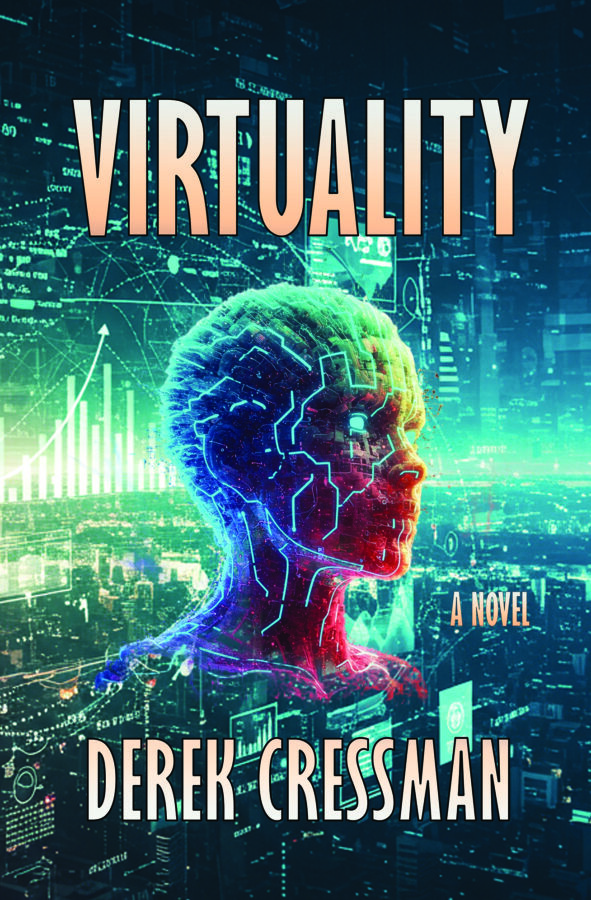

It's 2065 in Southern California. Virtuality's post-Orwellian, pre-Matrix satire is a near-future dystopia on the verge of collapse. When a mysterious hacker disrupts transmissions, four quirky misfits find out that the streaming infotainments of their customized MyndScreen(TM) brain implants have noxious side effects-not to mention the addictive free extruded soyalgent food that everyone's eating. Who will succumb to corporate commercialism on steroids? Who will survive the apocalypse?
Editors:
Cover Artists:
Genres:
Tropes: Band of Misfits, Dystopian Governments
Setting: Southern California
Languages Available: English
Tropes: Band of Misfits, Dystopian Governments
Setting: Southern California
Languages Available: English
Mark Heisey on The US Review of Books wrote:A dystopian tour de force with resounding thematic power, Derek Cressman’s novel, Virtuality, chronicles a world where society’s addiction to virtual reality—particularly viewing endlessly streaming “infotainment” and mindlessly consuming advertisement-fueled products—has created generations of nonthinkers with the attention span of mayflies.
The story is set in a near-future SoCal where most inhabitants have cerebral implants connecting them online, and governments have merged with multinational corporations to create massive trade unions. America, for example, is now part of Globalia. The multiple points-of-view narrative follows a handful of characters as they search for meaning in a life fueled by delusion and misinformation.
Oscar Tamero and his 12-year-old sister are orphans. He survives due to his connection to the digital world (an interface called MyndScreen), which enables him to sell “bacco” illegally. But when his implant breaks, he suddenly sees the world anew.
Meanwhile, Caspian Blaine is about to be named president of a powerful tech company that specializes in increasing digital consumer connectivity and engagement, no matter the cost—but his real undertaking is to “plant the smallest seeds of… critical thought into a post-truth society that coped with the constant torrent of infotainment by disregarding it all as fake news.” As civilization rots from the inside and the global economy hurtles towards collapse, Tamero, Blaine, and others fight for themselves—and their future.
The novel offers crisp prose, with superb world-building. Its real power, however, lies in the truth underlying the dystopia; so many lines resonate in today’s society. At one point, for instance, a character says: “I’m still offline. It’s like I don’t exist.” Additionally, numerous scenes are haunting for the plausible, nightmarish future they foresee, like babies in warehouses with robot attendants and video screens running nonstop above their cribs.
Ready Player One meets Idiocracy meets 1984’s Oceania, this is a must-read for fans of thought-provoking science fiction—one with the potential to become a dystopian classic.
D. Donovan on Midwest Review of Books wrote:"We cannot let fearmongers divert Globalians' attention so we don't shop, don't watch, don't consume. Do not stop to smell the flowers or neglect your patriotic duty to view and consume."
This follow-up to Cressman's Reality 2048: Watching Big Mother includes a large cast of varied characters. Not only do Vera and Chase return from the earlier book, both stuck inside their entertainment homes with no outside contact, but there is also a young orphan named Ellen who is surprisingly raised offline by a nun, a teenager named Oscar who sells black market cigarettes and is raising his precocious sister, Luella, and a couple of high-ranking executives who believe their posh lifestyle is well-earned because they are secretly working against the system from the inside. Oscar indulges in a wild idea which leads him to attempt skiing in reality. This adventure will lead him to smash his VR implant and meet Ellen. Setting off a chain of events, a huge mega-philanthropic organization, whose ultimate goal is more consumption, winds up financing actual gardens on a bombed-out area that used to be Ellen's virtual child-rearing center. Oscar decides he should help Luella disconnect more often, while Ellen begins to think more seriously about finding her parents. When Luella beats another online player, Chase, and wins a bet for an old but real motorcycle, all the divergent characters' lives become entangled.
Much like the first novel, this dystopian tale leans heavily on the influence of works like Orwell's 1984 and Vonnegut's short story "Harrison Bergeron." Each presents a future where the individual is overruled by the ruling whole, and each is written with loads of satire. This second book also seems to be heavily influenced by Stephenson's Snow Crash. Both novels emphasize a future where virtual reality becomes a larger part of most characters' lives than the offline world around them. Governments are fractured, and corporations hold the most power. Additionally, this book features more action than the first, which is a characteristic Snow Crash also has in abundance. Where Stephenson's book focuses on a malicious and deadly virus, Cressman's work focuses more on breaking down virtual reality addiction and attempting to convince people to interact with each other and the natural world around them. Each book also features dystopian and slightly futuristic takes on transportation, electronic currencies, a black market where physical items are the products, and a metaverse built much like a modern MMO, where avatars are status symbols and consumption reigns. Interestingly, hackers become more like heroes than antiheroes in worlds where Big Brother is always online and watching.
Cressman's writing is sharp, often layered with quotable lines and interesting parodies. It was good in the first book, but it has improved in this one. The introduction of a larger cast of characters works well for him, and the book is even more engaging as a result. He takes a few additional risks in this book, and they pay off for the reader. There are still aspects that may raise some eyebrows, such as a too-easy conclusion and unrealistic recovery from people who have been strapped to chairs for nearly two decades, among other minor issues. However, not only is this book easy to recommend to anyone who enjoyed the predecessor, but it is also a book to recommend to anyone who enjoys dystopian and speculative fiction, although reading the first book will make the overall experience more rewarding.
RECOMMENDED by the US Review
A 2026 Eric Hoffer Book Award Nomination
Virtuality is set in 2065 in Southern California and adopts a high-tech pre-apocalyptic tone as a world replete with technological marvels and possibilities teeters on the edge of complete failure and disaster. With its high reliance on technology come the inevitable hackers who threaten everything, leading four misfits to step up to the seeming impossible task of stopping them.
When Oscar awakens in a San Bernardino convent, he's immediately cognizant that the "windows in his mind" are gone. The MyndScreen implant that has colored his world is missing. With its absence comes a rush of stimulus about reality that Oscar never received in the virtual world that directed his life and took away all vivid sensations.
The progression and disintegration of "real reality" and visual worlds move ever closer to a brink neither can recover from as those who have long chosen observation over personal involvement find their choices blurred and the results of their decisions stark and damning.
From eating real eggs and learning to chew solid food again to experiencing a brain in the process of reprogramming itself, descriptions vividly capture the nuances of this future and the rigors of living within and moving outside of it.
Libraries seeking dystopian novels about the move from high-tech to real-world experiences will especially appreciate how a variety of characters intersect on a broad playing field of possibilities and problems. This lends the story an immediacy and realistic overtone that embraces psychological revelation, motivations, and frightening possibilities of paradigm-changing actions.
As corporate commercial interests, issues of addiction and recovery, and virtual reality collide, a wide range of characters, from Chase and Vera to Caspian and Luella, find their lives and assumptions challenged and changed.
This transformative novel of the future provides plenty of moral, ethical, and technological fodder for book club discussions, offering much food for thought to individuals who love stories about future quandaries.
Received Honorable Mention in the 2026 Eric Hoffer Book Awards for Science Fiction


