
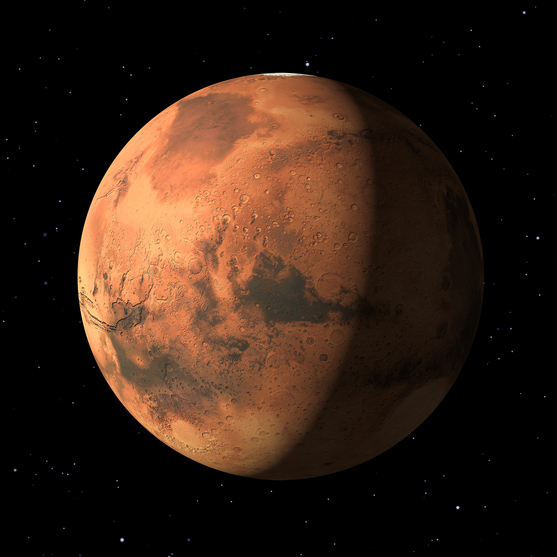
Tremendous tilts of Mars’ rotational axis during the past 20 million years may have dried out the planet, according to a new study. The findings may help solve the mystery of how Mars, which once contained lakes, rivers and possibly oceans, lost its water. Dry, dust-filled deserts cover much of Mars’ surface today. Astronomers think most of the planet’s scant water reserves are frozen within fine-grained surface dirt, with above-surface ice confined to the polar regions.
But the Red Planet hasn’t always been so dry. Gullies, lake beds and valleys photographed by early NASA missions like the Viking project suggest that since Mars’ birth, the planet’s surface has been periodically inundated by billions of gallons of liquid water. In fact, planetary scientists have calculated that the volume of water that carved out these geological features amounted to a layer at least 300 feet (100 meters) thick over the planet’s entire surface.
One hypothesis for where the water went is that much of it was “boiled” off. In a joint email to Live Science, Gabriella Gilli and Francisco González-Galindo, astronomers at the Astrophysics Institute of Andalusia in Spain and the new study’s first and second authors, respectively, explained this process.
“Writer Fuel” is a series of cool real-world stories that might inspire your little writer heart. Check out our Writer Fuel page on the LimFic blog for more inspiration.
