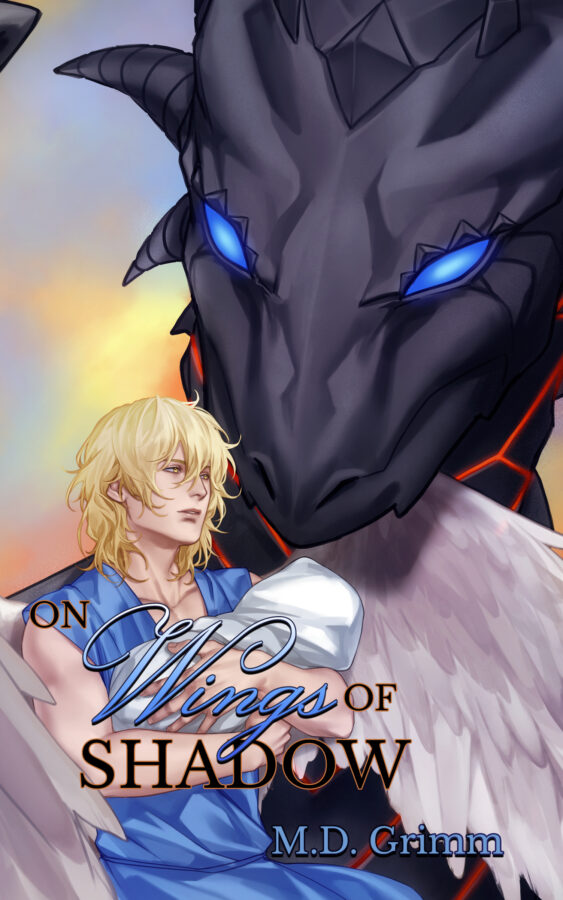
They flew back to New Haven together after Trystan threatened to leave Asagoroth alone at the beach if he didn’t return to the city. They had a son now, and Trystan wasn’t going to abandon him or hand over all the child-rearing to Annalise and Lasher. He wanted to play a major part in Adam’s life, and he also wanted that for Asagoroth.
Asagoroth landed gracefully on the long, rounded roof of Annalise’s home. The high chancellor’s residence wasn’t completed yet, but once it was, they would be moving. Trystan hoped he could remain here, since the roof was strong and the perfect size to accommodate a dragon of Asagoroth’s girth.
He tried to ignore the angels gaping and pointing while blushing at the hoots from the demons as they bowed and cheered to see Asagoroth.
Asagoroth rumbled for them, pleased with their attention. Arrogant beast.
Trystan swooped down and landed by the front door. He opened it but stopped short when he spotted Ragthorn sitting at a table with Annalise, deep in discussion. Sliced fruit and vegetables sat in bowls next to Annalise, forgotten in her focus. A bowl of bloody meat was beside Ragthorn, and he was absently tossing pieces in his mouth, nodding or grumbling over what she was saying.
“Trystan.”
He turned and accepted the bowl of fruit Lasher offered. “How long have they been at it?”
“Almost since you left,” he said, shrugging with an indulgent smile. “Much to do. Little time.”
His knowledge of Low Enochian had grown since he’d mated with Annalise, but his words were still heavily accented. Trystan was used to how he spoke and understood him well. He knew a few words of Dimoori from Asagoroth, but he’d yet to study the language.
“It’s time I interrupt them and make sure she eats. Thank you for the fruit.”
Lasher grinned and patted his shoulder.
“Oh, Asagoroth is back. He’s, uh, on the roof. Is that all right?”
Lasher’s eyes brightened. “I will pay my respects.” He hurried to the door but paused and glanced back. “The lumenus are sleeping but they might awaken soon.”
“The wha—”
He was gone, shutting the door behind him. Frowning, Trystan turned to Annalise and Ragthorn to find them staring at him.
“When did you get in?” she asked.
“Just now. Can I join? And you should eat.”
She blinked and then stared at the bowls. “How did those… Lasher.”
Ragthorn raised an eyebrow and tossed another scrap of meat into his mouth. “You just notice now? I have been eating for a while.”
Trystan chuckled as Annalise smiled sheepishly. He sat next to her, across from Ragthorn and munched on his own fruit.
“Asagoroth is back and he’s on the roof. I hope that’s all right?”
“I had it designed that way for that purpose.”
“You never miss a trick.”
She tossed her hair playfully before inspecting the food in the bowls. “I love my mate. He knows all my favorites.”
“He went to speak to Asa by the way. Also, he said the, what, lumen… something are sleeping.”
She nodded. “Lumenus. Singular is lumenu. It’s what we named the children. They are neither angel nor demon but both and other. So they need a name. It’s a compound word and means “Children of Divine Union” in Low Enochian. The other knowledge keepers and I have been working on several options since we settled here. The council voted before I took office, and we think this one fits the best.”
“Huh. Lumenu. I like it.”
It is a fine name.
Trystan smiled and continued eating. While he’d only told Annalise about communicating with Asagoroth mentally, he was sure Lasher suspected, though no one else knew. He wasn’t about to enlighten them.
“Ragthorn and I have been discussing a change to who is on the council, especially on the angel side.”
Trystan raised an eyebrow. “Who did you have in mind?”
“I want the council to better represent who is in our community. Ragthorn will take point on the demons but as for the angels… I want another unchosen.”
Wincing, Trystan stood to retrieve water. “Good luck with that.”
Annalise huffed. “I was voted high chancellor, and it is well within my rights to name whoever I please.”
“Uh-huh. But who will you be removing?”
She slumped. “That’s the problem.”
He nodded and passed them all jeweled glasses of water before reclaiming his seat. “Is there any reason we can’t enlarge the council and name a few more angels and demons to its ranks?”
“There’s no law against it, no. But I don’t know if that’s the best course.”
He nodded.
Ragthorn finished his bowl of meat and gulped down the water. “Before I take my leave, I wanted to tell you a concern I have.”
Annalise leaned forward and nodded. Trystan started to stand but Ragthorn waved him down.
“Please stay.”
He did, curious.
“A few demons have approached me and mentioned their angel mates are… disappointed that the lumenus have no wings. When they were first born, I heard only confusion but that has turned into resentment. Mostly from angelic fathers, though a few angelic mothers have… expressed disappointment about the perceived lack.”
Dread filled Trystan as Annalise frowned.
“Have no demons expressed such disappointment or made complaints?” she asked.
“Not that I have heard.” He shook his head. “I do not wish for the lumenus to grow up thinking they are lesser and unwanted.”
Trystan swallowed hard. He had also wondered why the children… the lumenus didn’t have wings. All angels and demons had wings so why this trick of biology? Or was it like Lasher said at their birth, they were made for the Middle Realm and didn’t need wings? But creatures here did have wings, so why not them? They would never experience the joy of flying, of feeling the wind comb through their feathers, of the exhilaration of the dive and the pull up. Of swooping and playing and traveling at great speeds.
But he couldn’t condone expressing that disappointment. Maybe the lumenus couldn’t understand now but what about when they could? It almost sounded like they were blaming the children for not having wings. It wasn’t their fault.
Annalise laid a hand on his arm. “No, none of us do. I will call a council meeting this week, and we will discuss how to address the situation. Thank you for bringing this to my attention. I’m glad the demons feel comfortable telling you about their concerns.”
“That is why you made me deputy,” he said smugly.
She grinned. “Yes, that’s exactly why.”
As Ragthorn opened the door to leave, he ran into Lasher. They spoke a moment in quiet Dimoori before swapping places, and Lasher shut the door. He opened his mouth but wailing from the back room had all three of them rushing to the five infants.
Trystan picked up Adam while Lasher and Annalise each took two of theirs.
“I really appreciate you looking after him. Asa and I needed some time to ourselves.”
Annalise held Enlil and Eve, swaying as she moved to one of the stools in the room. “We’re happy to do it. But you’ll be repaying us later.”
He smiled. “I suspected as much.”
They expect me to look after five infants?
Trystan snickered at Asagoroth’s incredulity as he fed Adam. Derra and the other midwives had found what they needed for a breast milk substitute, and Adam guzzled it gladly.
I’ll be there, too. Big tough dragon like yourself shouldn’t be scared of a few infants.
Scared?
He choked down a laugh at Asagoroth’s indignation. “I’ll be back.”
Annalise nodded as she fed two of the infants at once while Lasher rocked the other two as they fussed.
Trystan grabbed a spare blanket from his room before stepping outside and flying to Asagoroth. His dragon hadn’t moved, still draped over the roof and the covered corridors. His eyes gleamed in the failing light as he eyed Trystan and Adam.
“There’s no reason to be afraid of him.”
I’m not.
Trystan stepped closer, his wings fluttering for balance on his precarious perch. Adam finished his bottle, and Trystan set him against his shoulder, patting his back. Asagoroth watched intently, as if viewing the most fascinating process in the world.
“I want to be good at this. I need to be.” He took a deep breath when Adam burped. “When you were gone, there were nights he just seemed to cry all the time. I’d never felt like such a failure. Sure, I’ve been told from day one that my existence was a failure but… I want to be a good father for him.”
Asagoroth crooned, his warm breath ruffling Trystan’s hair.
You are not a failure. You could never be. You are my angel, and you are everything. And the babies do nothing but cry. At least we have only one. Your sister has many.
Asagoroth had a point. Trystan remembered the panic he’d felt when her four children had cried at once. He’d tried to help but their distress had eaten at his gut.
COLLAPSE